Pearl Mae Bailey: The Definitive Biography, Career Earnings, and Enduring Cultural Legacy
Quick Facts Overview Early Life and Roots of Pearl Mae Bailey
Pearl Mae Bailey was a transformative figure in 20th-century American entertainment. Over a career spanning five decades, she established herself as an elite vocalist, comedic stage icon, Tony and Emmy Award–winning actress, bestselling author, and diplomatic envoy. From the vaudeville circuits of the 1930s to the bright lights of Broadway and the halls of the United Nations, Bailey broke racial and institutional barriers with a disarming blend of warmth, sharp comedic timing, and unmistakable musical phrasing.
At the time of her passing, Bailey had an estimated net worth of $2.5 million to $4.0 million. This translates to roughly $6 million to $9.5 million today. Her fortune was built on record-breaking Broadway box office revenue, major television and Hollywood film contracts, high-yield commercial endorsements, and a steady stream of book royalties.
| Quick Fact Dimension | Key Details |
| Full Legal Name | Pearl Mae Bailey |
| Birth Date & Place | March 29, 1918 (Newport News, Virginia, U.S.) |
| Date & Place of Death | August 17, 1990 (Philadelphia, Pennsylvania, U.S.) |
| Cause of Death | Coronary artery disease / Heart failure |
| Estimated Net Worth at Death | $2.5 Million – $4.0 Million USD (1990) |
| Spouses | John Randolph Pinkett (m. 1948–1952), Louie Bellson (m. 1952–1990) |
| Children | Tony Bellson (son), Dee Dee Bellson (daughter) |
| Highest Education | B.A. in Theology, Georgetown University (1985, age 67) |
| Major Accolades | Special Tony Award (1968), Daytime Emmy (1986), Presidential Medal of Freedom (1988), Screen Actors Guild Life Achievement Award (1976) |
Early Life, Roots, and Vaudeville Beginnings
Pearl Mae Bailey was born on March 29, 1918, in Newport News, Virginia, to the Reverend Joseph James Bailey and Ella Mae Ricks Bailey. Growing up in a household steeped in faith and music, she developed an intuitive vocal ear early in life. However, when her parents divorced, Bailey moved north with her mother and siblings to Philadelphia, Pennsylvania, a city that served as the launching pad for her entertainment career.
Her older brother, Willie “Bill” Bailey, was already making a name for himself as an exceptionally talented tap dancer. Inspired by his stage presence, fifteen-year-old Pearl entered an amateur talent contest at Philadelphia’s historic Pearl Theatre in 1933. Singing the classic standard “Poor Butterfly,” she took first prize: five dollars and a week-long professional engagement.
Shortly after, she entered and won the world-famous Amateur Night at the Apollo Theater in Harlem, New York. Consequently, those early victories convinced her to leave high school and pursue stage performance full-time.
Throughout the late 1930s, Bailey honed her craft across the East Coast vaudeville and cabaret circuits, often enduring the harsh economic realities of the Great Depression and the pervasive segregation of the Jim Crow era. Instead, rather than following the conventional vocal styling of the era’s crooners, Bailey developed a distinct performative voice: a relaxed, almost lazy phrasing mixed with spontaneous monologues, wry comedic asides, and expressive hand gestures.
During World War II, Bailey joined the United Service Organizations (USO), performing for thousands of American soldiers across military bases in the United States and abroad. This relentless touring schedule perfected her crowd work and laid the foundation for her transition into major metropolitan nightclubs.
Even decades after her passing, Pearl Bailey’s Net Worth continues to attract attention from fans interested in classic Hollywood legends.
The Big Band Era, Nightclubs, and Breakthrough Singles
In addition, following her wartime tours, Pearl Mae Bailey secured high-profile bookings at leading New York nightclubs, similar to other famous stars, including the Village Vanguard in Greenwich Village and the Zanzibar on Broadway. It was during a 1944 residency at the Zanzibar that legendary bandleader Cab Calloway heard Bailey perform and invited her to join his touring orchestra.
As a result, her tenure with Calloway exposed her to mainstream national audiences and leading jazz arrangers. Throughout the 1940s and early 1950s, she collaborated and recorded with jazz giants such as Duke Ellington, Count Basie, and Don Redman.
In 1952, Bailey scored a massive mainstream pop crossover hit with the single “Takes Two to Tango” (recorded for Coral Records). The track climbed into the top 10 on the national Billboard pop charts, selling hundreds of thousands of copies and establishing her as a commercially viable recording artist capable of headlining major venues across the country.
Broadway Stardom: St. Louis Woman to Hello, Dolly!
Bailey’s natural comedic timing and commanding stage presence made Broadway a natural arena for her talents. Over the course of three decades, she starred in landmark stage productions that redefined theatrical history.
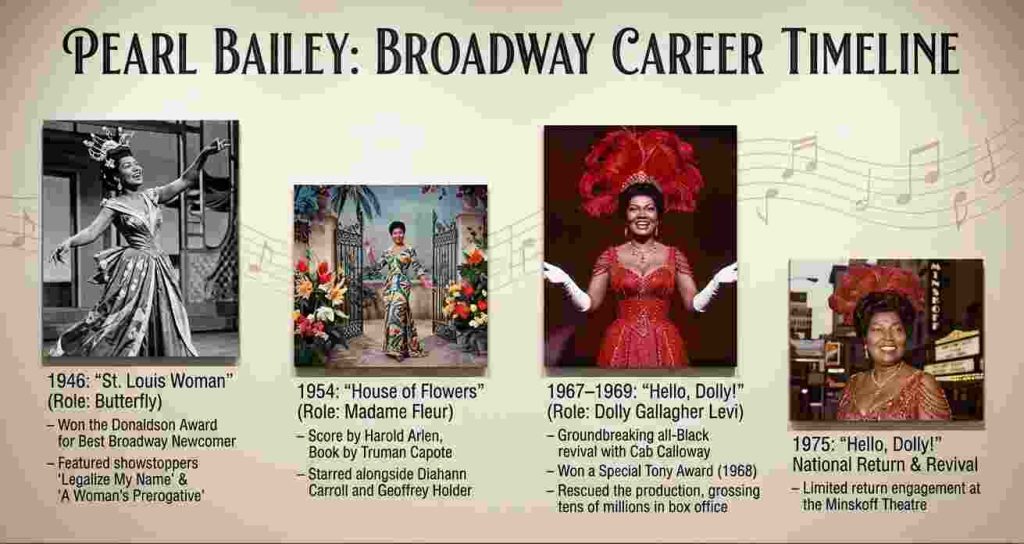
St. Louis Woman (1946)
First, Bailey made her Broadway debut in the Harold Arlen and Johnny Mercer musical St. Louis Woman, directed by Rouben Mamoulian. Playing the worldly character Butterfly, Bailey stopped the show nightly with her renditions of “Legalize My Name” and “A Woman’s Prerogative.” Her performance won critical acclaim and earned her the prestigious Donaldson Award for Best Broadway Newcomer.
House of Flowers (1954)
In 1954, Bailey took the lead role of Madame Fleur. She starred in Harold Arlen and Truman Capote’s musical House of Flowers. Sharing the stage with a young Diahann Carroll, Bailey dominated the production with her comedic timing and showmanship, reinforcing her status as one of Broadway’s premier box-office draws.
The Phenomenon of Hello, Dolly! (1967–1969)
Indeed, Bailey’s greatest theatrical triumph occurred in November 1967, when theatrical producer David Merrick took a massive commercial gamble. Facing declining ticket sales for the long-running musical Hello, Dolly!, Merrick recast the entire production with an all-Black ensemble starring Pearl Bailey as Dolly Gallagher Levi and Cab Calloway as Horace Vander Gelder.
The result was an unprecedented critical and financial blockbuster:
Later, in her 1975 revival, the Minkoff Theatre hosted a celebrated limited run that generated substantial box office grosses and closed out her Broadway stage legacy.
Box Office Miracle: As a result, the show sold out months in advance, generating millions of dollars in ticket sales and breathing new commercial life into the Broadway industry.
Special Tony Award: In 1968, Bailey was awarded a Special Tony Award for her historic contribution to the American theatre.
Original Cast Recording: RCA Victor rushed the cast into the recording studio, producing an LP that earned Gold record status and dominated the holiday sales charts.
Hollywood Filmography & Television Career
Similarly, Bailey’s success on stage translated quickly to the silver screen and network television. Furthermore, she refused to accept submissive, stereotypical roles common for African American actors in mid-century Hollywood, insisting instead on roles that allowed her charisma, intelligence, and musical gifts to take the lead.
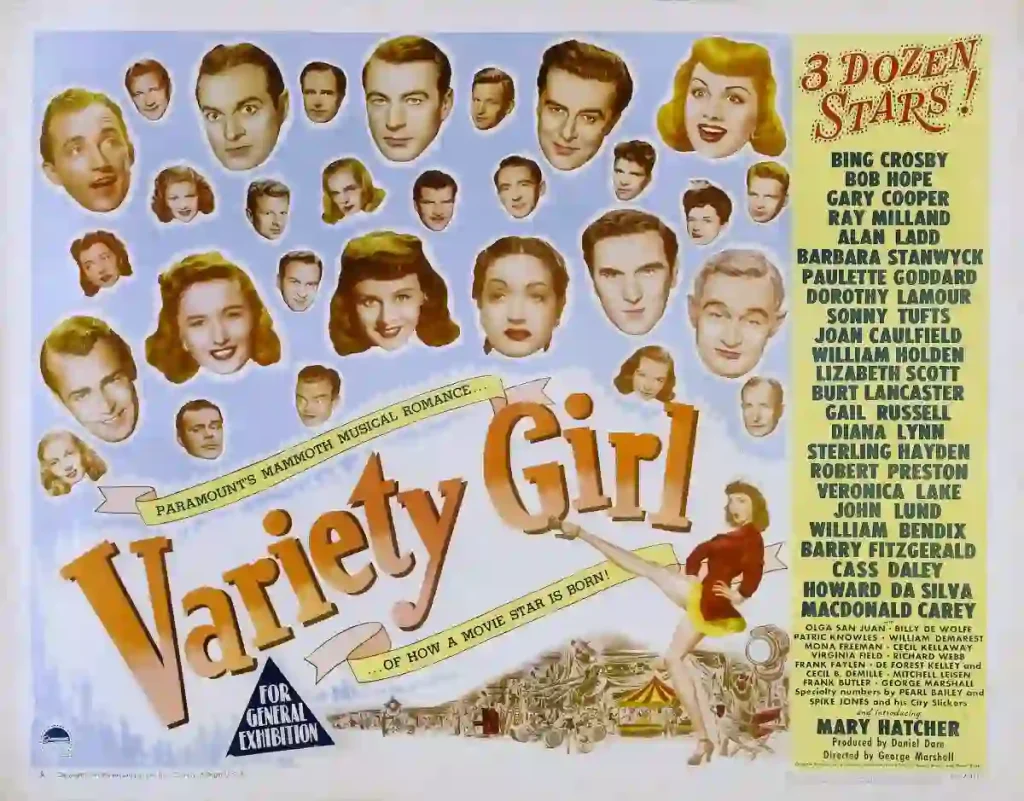
Pearl Mae Bailey in Variety Girl (1947)
This musical comedy marked Pearl Bailey’s feature film debut. In this Paramount Pictures star-studded revue, she delivered a standout musical specialty performance alongside Paramount’s top contract stars, establishing her signature style and magnetic stage presence on the big screen.
Carmen Jones (1954)
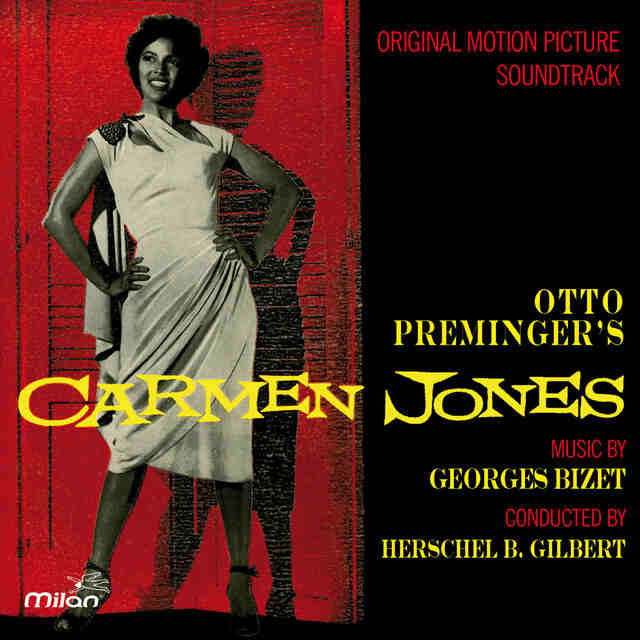
Pearl Bailey delivered a breakout performance as the energetic and fiery Frankie in Otto Preminger’s landmark film. Furthermore, she stole the screen with her unforgettable rendition of Bizet’s Romani Song (“Beat Out Dat Rhythm on a Drum”), showcasing her signature comic timing, rich vocal personality, and magnetic presence.
St. Louis Blues (1958)
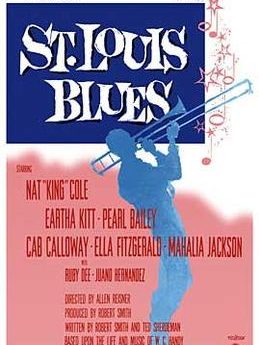
In this cinematic tribute to W.C. Handy—the “Father of the Blues”—Pearl Bailey delivers a standout performance as Aunt Hagar, a pivotal figure who provides warmth, emotional support, and musical encouragement to Handy (played by Nat King Cole). Beyond her dramatic presence, Bailey’s signature charm and soulful vocal delivery shine through in her musical numbers, making her a vibrant centerpiece alongside Nat King Cole.
Porgy and Bess (1959)
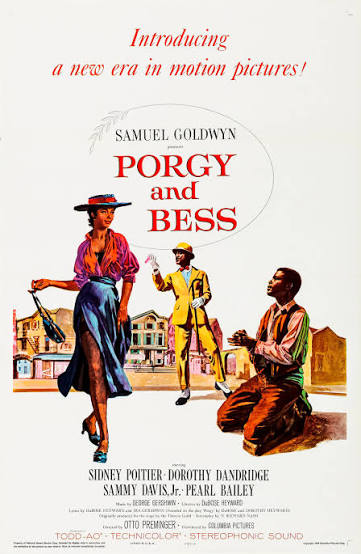
Similarly, in Samuel Goldwyn’s star-studded cinematic adaptation of George Gershwin’s opera, Pearl Bailey shined as Maria, the outspoken cook and matriarchal figure of Catfish Row. Bailey brought her signature wit, warmth, and commanding screen presence to the role, serving as the community’s moral anchor. Her memorable performance featured the song “I Hates Yo’ Guttin’ Guts,” where she displayed her iconic sharp humor while standing up against the villainous Sportin’ Life (played by Sammy Davis Jr.).
Television Mastery and The Pearl Bailey Show
Throughout the 1950s and 1960s, Bailey was a staple on prime-time variety shows, making frequent appearances on The Ed Sullivan Show, The Tonight Show Starring Johnny Carson, The Mike Douglas Show, and The Hollywood Palace.
In January 1971, ABC signed Bailey to host her own prime-time musical variety series, The Pearl Bailey Show. Filmed in Los Angeles, the series showcased high-profile collaborations with musical and cultural icons including Lucille Ball, Bing Crosby, B.B. King, Sarah Vaughan, and Louis Armstrong (marking one of Armstrong’s final televised performances prior to his death).
In 1986, Bailey won a Daytime Emmy Award for Outstanding Performer in Children’s Programming for her portrayal of a fairy godmother in the ABC Afterschool Special Cindy Eller: A Modern Fairy Tale.
Personal Life, Marriage to Louie Bellson, and Georgetown Degree
Marriage to Louie Bellson
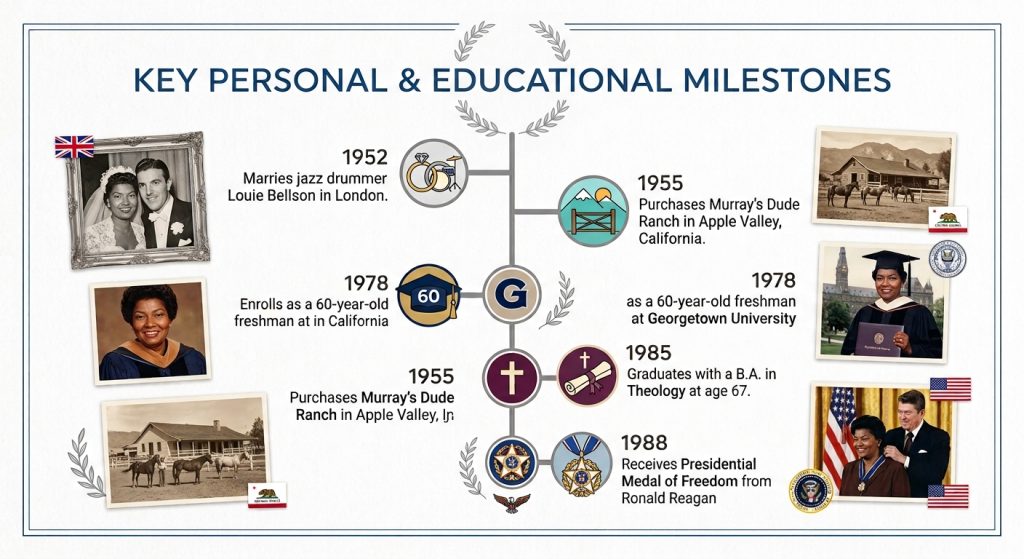
Meanwhile, in 1952, Pearl Mae Bailey met jazz drummer and composer Louis Bellson Jr. (Louie Bellson), who was then performing with the Duke Ellington Orchestra. The couple married in London on November 19, 1952.
At the time, their marriage was an interracial union during an era when miscegenation laws remained on the books in dozens of U.S. states. Despite facing racial hostility, public scrutiny, and occasional professional boycotts, their partnership endured for 38 years until Bailey’s death in 1990. Together, they built a stable family life, adopting a son, Tony Bellson, in the mid-1950s, and later having a daughter, Dee Dee Bellson (who went on to become a professional jazz and pop vocalist).
Pearl Mae Bailey: Academic Triumph at Georgetown University
In 1978, at the age of sixty, Bailey made the decision to return to formal education. Having left high school in her teens to support her family, she enrolled as a freshman at Georgetown University in Washington, D.C.
Meanwhile, over the course of seven years, balancing public speaking, writing, and family responsibilities, Bailey completed coursework in theology, philosophy, and classical history. She studied closely under notable Belgian philosopher and Georgetown professor Wilfrid Desan. In May 1985, at age 67, Bailey received her Bachelor of Arts (B.A.) in Theology from Georgetown University. She described this as one of the proudest moments of her life.
Diplomatic Service, Authorship, and High Honors
Diplomatic Service and the United Nations
However, beyond her artistic career, Bailey served as a public diplomat. In 1970, President Richard Nixon officially designated her America’s “Ambassador of Love” in recognition of her ability to bridge social and political divides through humor and goodwill.
Later, in 1975, President Gerald Ford appointed Bailey as a Special Delegate to the United Nations General Assembly. She continued her diplomatic service under Jimmy Carter and Ronald Reagan. During this time, she spoke on poverty, humanitarian aid, and human rights.
Published Books and Literary Legacy
Bailey was a prolific and candid writer, authoring six published books:
Personal Memoirs and Commentary
- The Raw Pearl (1968): Her bestselling initial autobiography detailing her rise from poverty to Broadway stardom.
- Talking to Myself (1971): A collection of personal essays exploring philosophy, friendship, race, and entertainment.
- Pearl’s Kitchen: An Extraordinary Cookbook (1973): A mix of Southern recipes, culinary advice, and personal anecdotes.
Later Writings and Reflections
- Duey’s Tale (1975): An allegorical children’s book that won the prestigious Coretta Scott King Author Award in 1976.
- Hurry Up, America, and Spit (1976): A collection of direct commentaries on American morality and community responsibility.
- Between You and Me: A Heartfelt Memoir on Learning, Loving, and Living (1989): A reflective memoir focusing on her experiences as a mature student at Georgetown.
Major Lifetime Honors
- Donaldson Award (1946) – Best Broadway Newcomer (St. Louis Woman).
- Special Tony Award (1968) – For her historic performance in Hello, Dolly!.
- Screen Actors Guild Life Achievement Award (1976) – The first African American performer to receive this honor.
- Coretta Scott King Book Award (1976) – For Duey’s Tale.
- Daytime Emmy Award (1986) – For Cindy Eller: A Modern Fairy Tale.
- Presidential Medal of Freedom (October 17, 1988) – Conferred by President Ronald Reagan, recognizing her exceptional contributions to American culture and world diplomacy.
- Hollywood Walk of Fame – Star dedicated at 7080 Hollywood Boulevard (Live Performance category).
Detailed Financial Estate and Lifetime Wealth Analysis
Pearl Bailey was one of the top-earning Black entertainers of the 20th century. Her estimated net worth of $2.5 million to $4.0 million at the time of her death in 1990 was built on multiple distinct revenue streams:
Broadway Performance Contracts & Box Office Cuts
Bailey’s contract for the 1967–1969 run of Hello, Dolly! was among the most lucrative of its time. Producer David Merrick provided her with an unprecedented weekly salary along with a percentage cut of the box-office gross. During sold-out weeks at the St. James Theatre, Bailey was earning substantial five-figure weekly payouts.
Commercial Endorsement Deals
Moreover, during the 1970s and 1980s, Bailey became a familiar face in American households through long-running corporate sponsorship campaigns. She signed multi-year television contracts with Duncan Hines, famously singing “Bill Bailey, Won’t You Please Come Home” in commercial spots that ran nationwide. Additional commercial contracts included Jell-O, Westinghouse, and Paramount Poultry.
Real Estate Holdings & Asset Distribution
- Murray’s Dude Ranch (Apple Valley, CA): In 1955, Pearl Mae Bailey purchased Murray’s Dude Ranch, a historic 40-acre resort property in Bell Mountain/Apple Valley, California. The property had historically served as an integrated retreat for Black celebrities and travelers who were excluded from segregated desert resorts.
- East Coast Estates: In addition, in her later years, she maintained private residential properties in Philadelphia and Lake Harmony, Pennsylvania.
- Estate Distribution: Upon her death in August 1990, her financial assets, intellectual property rights, publishing royalties, and catalog residuals passed to her husband, Louie Bellson, and their two children.
Final Years, Passing, and Enduring Influence
However, in the late 1980s, Bailey maintained a demanding schedule of university studies, public lectures, and television appearances despite managing coronary artery disease and severe arthritis.
Sadly, on August 17, 1990, while staying at the Thomas Jefferson University Hospital hotel in Philadelphia, Pennsylvania, Bailey collapsed and passed away at the age of 72. An autopsy confirmed the cause of death was heart failure brought on by arteriosclerotic coronary artery disease.
Her funeral service at Philadelphia’s Deliverance Evangelistic Church drew thousands of mourners, including prominent figures from Broadway, jazz, and national government. Louie Bellson and her children preserved her legacy, ensuring her recordings, books, and philanthropic endeavors continued to support arts education.
Ultimately, Pearl Bailey remains an enduring figure in American cultural history. By combining world-class musicianship, uncompromised artistic integrity, and groundbreaking achievements in education and diplomacy, she demonstrated how entertainment can break barriers, enrich communities, and leave a permanent mark on American life.
Frequently Asked Questions (FAQ)
At the time of her passing on August 17, 1990, Pearl Bailey had an estimated net worth of $2.5 million to $4.0 million (equivalent to roughly $6 million to $9.5 million today, adjusted for inflation). Her wealth was accumulated through lucrative Broadway box office profit-sharing, headline television contracts, commercial endorsement residuals, and publishing royalties.
Pearl Bailey was married to legendary jazz drummer and composer Louie Bellson (Louis Bellson Jr.) from November 19, 1952, until her death in 1990. Their 38-year interracial marriage was a high-profile union during the Civil Rights era. Prior to marrying Bellson, she was briefly married to John Randolph Pinkett (1948–1952).
Yes. Pearl Bailey and Louie Bellson raised two children together:
- Tony Bellson: Adopted in the mid-1950s.
- Dee Dee Bellson (Dee Dee Jean Bellson): Born on April 20, 1960, who became an accomplished jazz and pop vocalist touring internationally.
Pearl Bailey rose to international fame through her work across multiple entertainment and public service fields:
- Broadway & Stage: Winning a Special Tony Award in 1968 for headlining the record-breaking, all-Black Broadway revival of Hello, Dolly! opposite Cab Calloway, as well as starring in St. Louis Woman (1946) and House of Flowers (1954).
- Hit Music & Jazz: Scoring top-10 pop hits like “Takes Two to Tango” (1952) and recording with Duke Ellington and Count Basie.
- Television & Film: Hosting ABC’s The Pearl Bailey Show (1971), starring in classic films such as Carmen Jones (1954) and Porgy and Bess (1959), and voicing Big Mama in Disney’s The Fox and the Hound (1981).
- Authorship & Diplomacy: Authoring six books (including the Coretta Scott King Award–winning Duey’s Tale), earning a B.A. in Theology from Georgetown University at age 67, and serving as a U.S. Delegate to the United Nations.
Her most notable accolades include:
- Special Tony Award (1968) for Hello, Dolly!
- Screen Actors Guild Life Achievement Award (1976) — the first African American performer to receive this honor
- Daytime Emmy Award (1986) for Cindy Eller: A Modern Fairy Tale
- Presidential Medal of Freedom (1988) presented by President Ronald Reagan
- Hollywood Walk of Fame Star located at 7080 Hollywood Blvd